Miami-Dade County · High-Velocity Hurricane Zone
Roofing in Kendall, FL
Kendall is not a city. It is an unincorporated Census area of Miami-Dade County between U.S. 1 and the Turnpike's Homestead Extension, so every roof permit here goes through the county, not a city hall.
FL Certified Roofing Contractor CCC1335466
The houses trace Miami's march west: 1950s subdivisions near Dadeland first, then growth pushing toward the Turnpike. In 1992 the zone of Hurricane Andrew's extreme damage began here, and police named Devonaire one of four especially hard-hit areas of South Dade. If you own a house in Kendall, your roof falls under Miami-Dade's High-Velocity Hurricane Zone (HVHZ) rules, and replacing it is when the state's hurricane-mitigation retrofit requirements reach your roof deck.
Your roof in Kendall at a glance
- Who issues roof permits
- Miami-Dade County Department of Regulatory and Economic Resources (RER), Construction, Permitting and Building Code Division1,2
Kendall is unincorporated, so there is no city building department: Miami-Dade County issues every roof permit here, online through the county's E-Permitting system for qualified contractors or in person at the Herbert S. Saffir Permitting and Inspection Center (11805 SW 26th St.), and applications submitted from Dec. 31, 2026 (online, after 4 p.m. on Dec. 30) fall under the Florida Building Code 9th (2026) Edition.
Kendall is an unincorporated community, so there is no city building department: roof permits come from Miami-Dade County.
- Code that governs
- Florida Building Code, 8th Edition (2023), including the High-Velocity Hurricane Zone (HVHZ) chapters
- Product approval
- Miami-Dade NOA, or a Florida Product Approval listed for HVHZ use, for every roof component.
- Design wind speed
- Miami-Dade sits in the High Velocity Hurricane Zone (HVHZ). Florida Building Code 8th Edition (2023) section 1620.2 sets one design wind speed for the whole county instead of a map range: 175 mph (3-second gust) for homes and other Risk Category II buildings, and 186 mph for Risk Category III.3,4
- Homes
- Median home built in 1978. 90.7% of 32,492 homes were built before 2000; 40.4% are detached single-family houses.5
- Neighborhoods
- Dadeland · Devonaire · East Kendall · South Kendall
What is on the roofs in Kendall
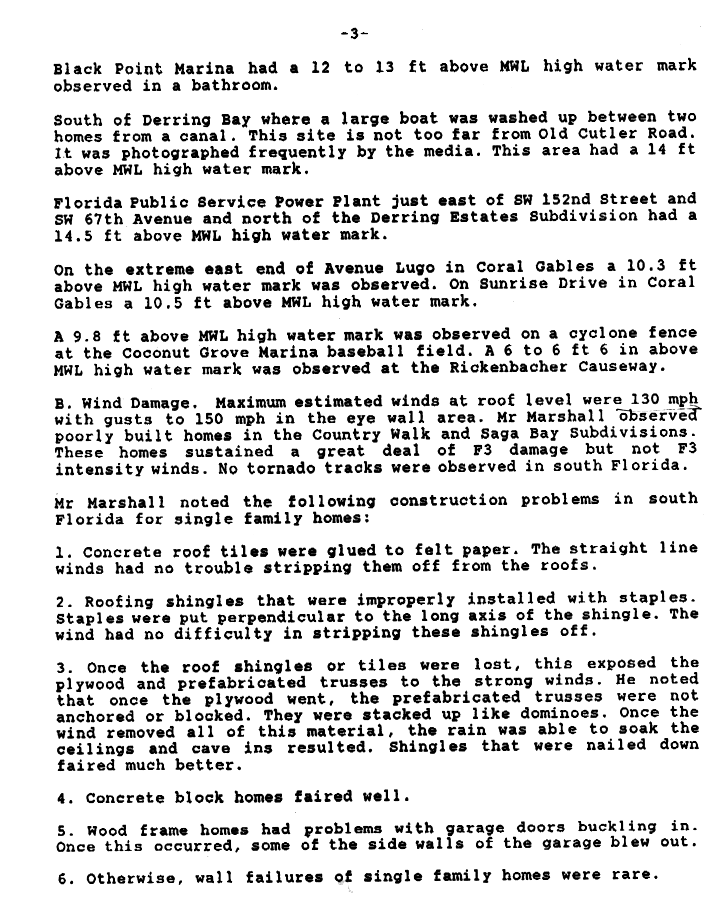
Kendall was built from east to west. In the 1950s the name spread to new subdivisions near what is now Pinecrest, Dadeland Mall opened in 1962, and in the 1970s, '80s and '90s growth shifted west, carrying the Kendall name with it. Many older houses here went through Hurricane Andrew, and a 1992 engineering survey of South Florida relayed to the National Hurricane Center found that wind had no trouble stripping concrete tiles glued to felt paper and shingles stapled the wrong way. When a single-family roof is replaced today, the county's hurricane-mitigation retrofit forms, issued under Florida statute, cover roof-deck attachment and a secondary water barrier, and roof-to-wall connections unless the owner qualifies for the posted exemption.1,6,7,8
Local rules and history that affect your roof
- U.S. 1 is Kendall's eastern edge, and the Village of Pinecrest is on the other side. Pinecrest was counted inside the Kendall CDP until it incorporated in 1996, so older records can put Pinecrest homes "in Kendall." Before a contractor files anything, confirm which side of U.S. 1 your house is on: Kendall addresses are permitted by Miami-Dade County, while Pinecrest is a separate municipality with its own government.2,6
- Much of what is now Kendall was bought from the State of Florida in 1883 by the Florida Land and Mortgage Company and named for Henry John Broughton Kendall, a company director who later came to manage its land. The land was not open to homesteading and development was slow; before the 1950s the area was mostly pine rockland mixed with fields and groves.6,9
- Kendall marks the northern edge of the band where the National Hurricane Center rated Andrew's impact extreme, from the Kendall district south through Homestead and Florida City. Inside that band sits Devonaire, around SW 112th Street and 112th Avenue, which police singled out in 1992 as one of four especially hard-hit areas of South Dade.10,11,12
Storms that hit here
- Andrew (1992). In the Miami Herald's first report after the storm, police named Devonaire, around SW 112th Street and 112th Avenue inside today's Kendall CDP, one of four especially hard-hit areas in South Dade. The same report described Kendall pool covers ripped up, nearly every tree stripped bare and shingles torn off roofs.10,11,12
What this means for a re-roof in Kendall
How old the houses are. The median home in Kendall was built in 1978; 90.7% of its 32,492 homes predate 2000 and 4% were built in 2010 or later. So most houses here went up before Florida’s first statewide building code took effect on March 1, 2002.5,13,14,15
Pre-2002 wood-deck houses. When the old covering comes off, the deck gets re-nailed to current code and a secondary water barrier goes on; in the wind-borne debris region, insured homes of $300,000+ may also need roof-to-wall connections (capped at 15% of the re-roof cost).13,14,15
Repair or replace. Replacing 25% or more of a roof section in 12 months generally means redoing the section to current code — unless that roof was built or replaced under the 2007 code or later.14,15,16,17
Product approval. In the HVHZ every roofing component needs a current product approval — a Miami-Dade NOA or a Florida approval listed for HVHZ use. Ask for the numbers and look them up yourself.16,18
Roof age and insurance. An insurer can’t refuse a policy just because the roof is under 15 years old. If it is 15 or older, you can get an inspection first; at least 5 years of remaining life means age alone isn’t grounds to refuse.19
Roofing services in Kendall
Nearby areas
Sources
Facts on this page come from these public sources. Last checked September 2026.
- 1.Roofing Permits — Miami-Dade County Department of Regulatory and Economic Resources
- 2.Building (Construction, Permitting and Building Code Division) home page — Miami-Dade County Department of Regulatory and Economic Resources
- 3.2023 FBC Building, 8th ed., Section 1620 High-Velocity Hurricane Zones — Wind Loads — UpCodes (Florida Building Code text)
- 4.Benchmarks set for code-related approval of building products — Miami-Dade County
- 5.American Community Survey 2020–2024 5-year estimates (tables B25035, B25034, B25024, B25003) — U.S. Census Bureau, via Census Reporter
- 6.Kendall, Florida — Wikipedia (history section cites Jean Taylor, Villages of South Dade, 1985)
- 7.Dadeland Mall — Wikipedia (cites Miami Herald, July 14, 2013)
- 8.Hurricane Andrew Damage Assessment (memo, Sept. 10, 1992, relaying a Haag Engineering survey), page 3 — NOAA National Hurricane Center archive
- 9.The Stories Behind the Names of 25 Miami-Dade Cities and Neighborhoods — Miami New Times (Jan. 28, 2016)
- 10.Preliminary Report: Hurricane Andrew, 16-28 August 1992 — NOAA National Hurricane Center
- 11.A Look Back At Hurricane Andrew 25 Years Later (reprints the Miami Herald/AP report published after landfall in 1992) — WUSF Public Media
- 12.Census Geocoder: 11200 SW 112th St lies in Kendall CDP — U.S. Census Bureau
- 13.Florida Building Code Effective Dates — Florida Building Commission (floridabuilding.org)
- 14.2023 Florida Building Code, Existing Building, 8th ed., Chapter 7 (Section 706 Existing Roofing) — UpCodes (text of the Florida Building Code)
- 15.Florida Statutes 553.844, Windstorm loss mitigation; requirements for roofs and opening protection (2026) — Florida Legislature
- 16.2023 Florida Building Code, Building, 8th ed., Chapter 15 Roof Assemblies and Rooftop Structures (Sections 1511-1525) — UpCodes (text of the Florida Building Code)
- 17.SB 4-D (2022 Special Session D): Building Safety, Chapter 2022-269 — The Florida Senate
- 18.Product Control Search — Miami-Dade County
- 19.Florida Statutes 627.7011 (2026): Homeowners' policies; offer of replacement cost coverage and law and ordinance coverage — The Florida Legislature